


The hidden history beneath your feet: a Roman archaeology road trip through Fuengirola
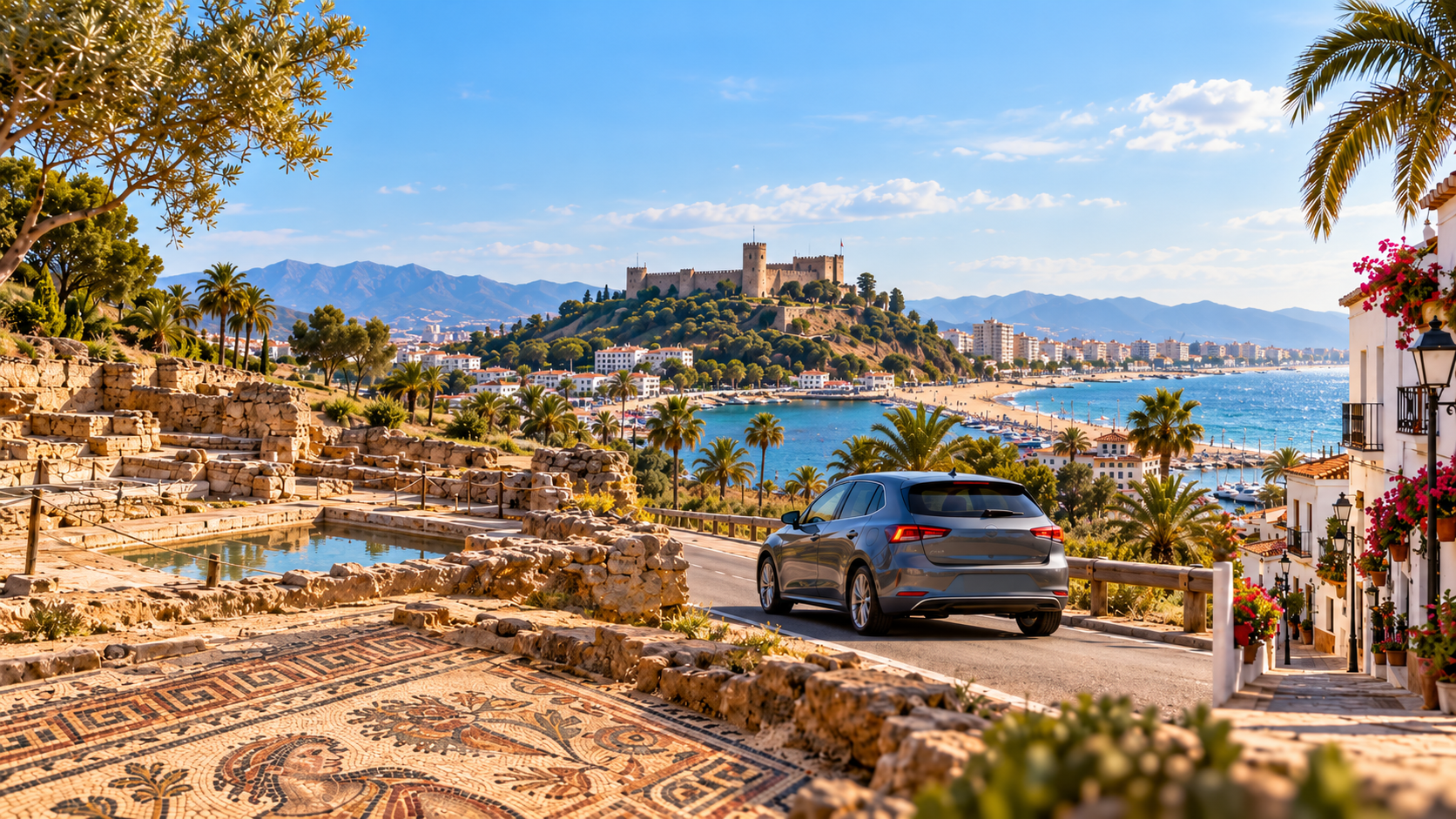
Ask any tourist what Fuengirola is all about and they’ll tell you about chiringuitos (beach bars), miles of sand and lively seafront promenades. But if you put the beach towel aside for a moment and look at the town with fresh eyes, you’ll realise you’re standing on more than two thousand years of history. Phoenicians, Punics and Romans already knew this corner of the Costa del Sol was a strategic spot: ancient Suel was here long before the beach bars.
The archaeological sites are spread across the municipality —one to the north, another by the river mouth, another to the east— so getting around in a hire car from Miami Car Hire lets you connect the dots of this story without relying on bus timetables or trudging under the sun with a backpack. Here is the route to discover the town’s hidden side.
1. First stop: the Roman Villa at Finca del Secretario
We begin with the most complete Roman site in town. Finca del Secretario lies in the Los Boliches area, towards the north of the municipality, next to the bypass and the railway line. Many locals drive past it without realising: beneath the traffic lie the remains of a large Roman villa with an industrial area and baths, in use from the late 1st century AD until at least the 4th century.
- Getting there: Access by car is easy from the bypass, but it’s worth setting the exact location in your GPS before you set off and leaving the car in a public car park nearby. Check the opening hours too: the interpretation centre is usually closed on Mondays and its hours change with the season (see turismo.fuengirola.es).
- What you’ll see: The remains of the bath complex —with rooms such as the caldarium, the hot room— and the industrial area, with the vats where fish was salted, one of the economic mainstays of ancient Suel. The interpretation centre has a reconstruction of the baths and a display of finds from the villa.
- The site’s treasure: This is where the Venus of Fuengirola was found, a 2nd-century marble sculpture restored in 2021 and now on display at the Town Hall. Picturing the people of Suel relaxing in these baths almost twenty centuries ago completely changes your perspective on what Fuengirola is.
2. Second stop: Cerro del Castillo and the traces of Suel
From Los Boliches, we get back in the car and head towards the mouth of the Fuengirola river to climb up to Cerro del Castillo (Castle Hill), the true historic heart of the municipality. On this hill stands Sohail Castle, and both form part of the same complex: the archaeological site of Suel.
- The drive: Take the “Castillo Sohail” exit off the motorway or follow the signs from the seafront promenade. It’s a short stretch, ideal for testing the agility of a compact or city car from our fleet.
- The setting: This headland wasn’t chosen at random: it controlled the river mouth —navigable in ancient times— and access from the sea. Phoenician-Punic, Roman and medieval settlements are layered on top of one another here. The castle you see today is a 10th-century Caliphal fortress, built over those earlier settlements.
- Don’t miss: At the foot of the hill, by the seafront promenade, you’ll find Roman vats once used to make garum, the famous fish sauce. It’s a detail that links directly to what you saw at Finca del Secretario.
- Driver’s tip: There’s a public car park next to the esplanade by the castle, and entry to the site is free. From the top, the views over the river mouth and the Mediterranean are spectacular.
Bonus stop: the Torreblanca Roman Baths
If you have time to spare, round off the route with the Roman Baths of Torreblanca del Sol, on Avenida de Torreblanca, towards the east of the municipality. Declared a Site of Cultural Interest (Bien de Interés Cultural) in 2005, the complex includes a 2nd-century AD bath building, a fish-salting factory and a necropolis used from the 5th century onwards. After years in private hands, the Town Hall acquired the land in 2017 and has prepared it for visitors, with walkways and information panels. It’s another example of how fish and fish products sustained the economy of ancient Suel. Before you go, check visiting hours on Fuengirola’s tourism website, as they may change.
Seafaring architecture and charming corners: the neighbourhoods mass tourism overlooks
Everyone knows Fuengirola’s town centre and the buzz of Los Boliches, but the town’s identity also lives on in fragments of its seafaring past. That tradition goes back a long way: even in Roman times the coast lived off fish and salted fish products. And before the tourist boom of the 1960s, this was still a modest fishing community.
If you want to get off the beaten track, leave the car in a car park and discover these corners.
1. The fishermen’s streets of Los Boliches
Although Los Boliches is now synonymous with life and activity, step into the streets running parallel to the beachfront and the pace changes instantly.
- The charm: Narrow streets and low whitewashed houses that recall the old fishermen’s quarter, small local shops and bars where pescaíto (fried fish) is still the star of the show.
- Why the car matters here: A nimble, sensibly sized car from Miami Car Hire gets you to the area with no hassle. That said, these lanes are best enjoyed on foot: park in a public car park and explore them walking.
2. The old town and Plaza de la Constitución
In the historic centre, around Plaza de la Constitución, stands the Church of Nuestra Señora del Rosario, dedicated to the town’s patron saint, whose festivities are held every October. The surrounding alleyways and little squares keep a much calmer pace than the seafront promenade.
- When to go: Spring, autumn or winter, away from the summer crowds, is the best time to stroll through these neighbourhoods and watch residents tending their flowerpots and chatting on their doorsteps.
- Where to park: Use the underground car parks near Plaza de la Constitución or the pay-and-display zones (zona azul) in the surrounding streets, and spend an hour wandering with no fixed route.
Quick planning table: Fuengirola’s history and neighbourhoods
| Themed route | Estimated time | Parking difficulty | Recommended vehicle |
| Roman sites (Finca del Secretario + Sohail Castle) | 3 hours (plus 1 hour if you add Torreblanca) | Low–medium (the castle has parking next to the esplanade) | Compact hatchback or mid-size SUV |
| Fishermen’s quarters and old town | 2 hours | Medium (narrow streets; public car parks are best) | City car or nimble compact |
Why explore Fuengirola on four wheels
The sites are far apart: Finca del Secretario to the north, the castle at the river mouth and Torreblanca to the east. On foot it would be a full day’s walk; by car it’s a comfortable morning. Hiring a car from Miami Car Hire gives you the freedom to go from the Roman history of Finca del Secretario to Sohail Castle, and from there to the fishermen’s streets of Los Boliches, with air conditioning and your belongings safe in the boot. Then you park up and explore the neighbourhoods at a leisurely pace on foot.
Next time you visit Fuengirola, don’t stop at the beach. Switch your GPS to explorer mode and discover what lies behind the façades.
